ISO9001 & CE Certified

Industries We Serve

Mold & Die Manufacturing

Drilling machines for mould cooling channels, ejector pins & hot runners

Drilling machines for moulds: deep hole gun drilling & BTA machines that drill cooling channels, ejector pin holes and hot runners in hardened mould steel, to 1,600 mm. Factory direct from RuidCNC.

Drilling Machines for Moulds

Cooling is what decides how fast an injection mould runs and how long it lasts. Every mould plate, insert and core is criss-crossed by cooling channels that pull heat out of the plastic, and those channels have to be deep, straight and cleanly finished to work. RuidCNC builds the drilling machines for moulds that machine them — the same machines that drill ejector pin holes, core pin holes, hot runner bores and die-cast die cooling circuits in hardened mould steel.

In short, a “drilling machine for moulds” is a deep hole drilling machine: a gun drilling machine for precision small-diameter channels, and a BTA machine when the holes get larger. If your job is a mould or die that needs deep hole drilling, this is the equipment and the application to start with.

What Mould Makers Drill

Mould and die work comes down to a handful of hole types, all of which ask the machine for the same things — straightness, roundness, surface finish and a predictable cycle:

  • Cooling channels — the backbone of mould thermal control. Deep, straight circuits drilled in plates and inserts, plus angled, crossed and stepped channels that follow the cavity. On a typical injection mould these are small-diameter holes that run the full length of the plate.
  • Ejector pin and core pin holes — long, small-diameter holes that must stay straight and round over their full depth so the pin moves freely and wears evenly across millions of cycles.
  • Hot runner, sprue bushing and nozzle holes — precision bores with tight diameter tolerance, usually finished to a smooth surface so polymer flows cleanly.
  • Venting and pilot holes — small, accurately positioned holes that support the rest of the machining sequence.

The common thread is depth relative to diameter. A 3 mm cooling channel drilled 300 mm through a mould plate is a 100:1 ratio — far beyond what a twist drill can hold straight, and exactly the region where gun drilling is the proven answer.

Which Drilling Machine for Moulds Should You Choose?

The right machine depends on the hole size, the depth, the angles and the part size. For mould and die makers, RuidCNC’s range splits cleanly:

  • Three Axis CNC Deep Hole Drilling Machine RD1010-10H — the standard entry point for mould shops. Drills 3–35 mm to 1,000 mm depth with CNC depth control. Ideal for vertical and horizontal cooling circuits and ejector pin holes in plates and inserts.
  • 5-Axis Vertical Type Deep Hole Drilling Machine — the machine for angled and intersecting cooling channels. A tilting/rotating cradle table drills complex channel geometry directly into inserts, replacing custom angle fixtures and second setups.
  • Small Deep Hole Drilling Machine — for fine work: 1.5–20 mm to 300 mm depth with ±0.005 mm repeatability. Suited to small inserts, venting holes and precision pilot holes.
  • RD1010-10M Gundrilling, Milling and Tapping Compound Machine — drills, mills and taps hot runner manifolds and complex die/mould components in a single setup, with a 24-position automatic tool changer and B-axis rotary table.
  • Gun Drilling on Glass Bottle Mold — a specialised two-spindle gun drilling machine for bottle mould cooling holes (2–12 mm to ~350 mm), combining gun drills with milling and tapping tools.
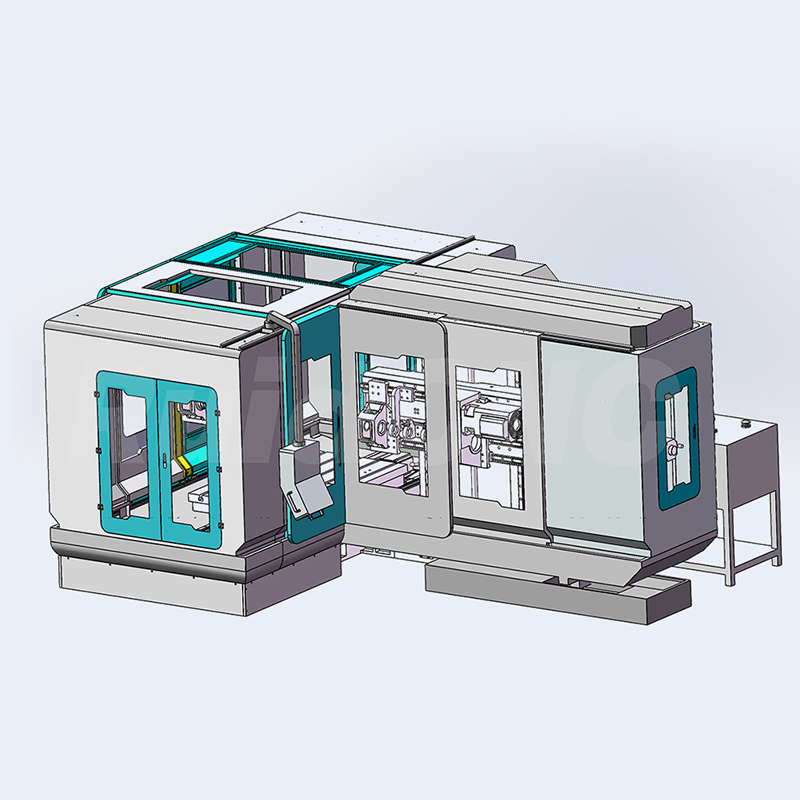
  • Horizontal Deep Hole Drilling Machine — for large dies and heavy workpieces (up to 18 t). Drills 3–50 mm to 1,600 mm and carries the bigger plates die-cast and structural mould work tends to produce.

Not sure which configuration fits? The deep hole drilling machine buying guide walks through the selection criteria, or send your mould drawing to our engineering team and we will recommend the machine and tooling.

Drilling Hardened Mould Steel

Most mould makers want to drill after heat treatment, because machining a soft plate and then hardening it moves the holes. RuidCNC machines are built to handle that: carbide gun drills and BTA tools machine pre-hardened mould steel up to roughly 50 HRC directly, with high-pressure through-tool coolant keeping the cutting edge cool and clearing chips from the hole.

The result is a hole drilled exactly where it was programmed, in the material state the mould will actually run in — no annealing, no re-drilling, no distortion. For the mould maker this compresses the process from anneal–drill–harden back to simply drill.

Proof in Mould Production

The mould and die application pages on this site show the machines on real work:

For the full capability summary of what RuidCNC configures for mould and die applications — tooling, coolant systems and machine selection — see the Mould & Die Deep Hole Drilling service.

Challenges

Industry Challenges

Complex cooling channel geometries requiring angled, crossed and stepped drilling in mould plates and inserts

Deep, small-diameter holes in hardened mould steel (up to 50 HRC) that conventional drills cannot hold straight

Ejector pin and core pin holes that must stay round, straight and smooth over long drilling depths

Hot runner and sprue/nozzle holes with tight diameter tolerance and good surface finish

Short cycle times and predictable tool life so mould production does not become the bottleneck

Minimising scrap on large, expensive mould plates where a drifted hole is a reworked or rejected plate

Solutions

Our Manufacturing Solutions

Drilling Machines Built for Mould Work

Purpose-built gun drilling machines that hold straightness and roundness through deep cooling channels in hardened mould steel, without annealing.

Three-Axis CNC Deep Hole Drilling

The RD1010-10H drills vertical and horizontal cooling circuits and ejector pin holes with CNC depth control and repeatable surface finish.

Five-Axis Vertical Drilling

5-axis vertical machines drill angled and intersecting cooling channels directly into complex mould inserts, without custom angle fixtures.

High-Pressure Coolant Systems

Through-spindle coolant up to 120 bar evacuates chips from the deepest cooling and hot runner holes, protecting the tool and the hole.

Application-Matched Gun Drills

Gun drill geometry and coatings optimised for mould steel, selected per material and hole specification to balance speed and tool life.

Applications

Specific Applications

Mould Cooling Channel Drilling

Deep, straight and conformal cooling circuits in mould plates, inserts and cores — including angled, crossed and stepped channels.

Ejector Pin & Core Pin Holes

Long, small-diameter holes with the straightness and surface finish ejector and core pins need to move reliably, run after run.

Hot Runner & Sprue Bushing Holes

Precision-drilled manifold, sprue bushing and nozzle holes for hot runner moulds, with tight diameter tolerance and clean finish.

Venting & Pilot Holes

Small venting and pilot holes drilled accurately to depth before the mould moves on to finishing operations.

Die-Cast Die Cooling

Larger-diameter cooling channels in die-cast dies, drilled with BTA tooling for high metal removal and predictable depth.

Trusted By Industry Leaders

Mould Cooling Channels, Ejector Pins & Hot Runner Holes — Mould & Die Makers Worldwide

Why RuidCNC

Why Partner With Us

Straight, Repeatable Cooling Holes

Gun drilling produces straight, round holes with smooth surfaces (down to Ra 0.8 µm) that cool evenly and stay clear of chips.

Drill Hardened Steel Without Annealing

Drill pre-hardened mould steel up to 50 HRC directly, eliminating the anneal–drill–re-harden cycle that slows mould making.

Angled & Cross-Drilled Capability

5-axis machines drill angled and intersecting channels that position cooling exactly where the mould needs it.

Mould-Specific Engineering Support

Our engineers spec the machine, gun drill geometry and coolant pressure for your plate size, hole pattern and material.

Factory-Direct Pricing

Buy the drilling machine direct from the manufacturer in Dongguan, China — no trading-company markup.

FAQ

Frequently Asked Questions

What is the best drilling machine for mould cooling channels?
For most injection moulds, a three-axis CNC gun drilling machine (such as the RD1010-10H, 3–35 mm to 1,000 mm depth) is the standard choice. For angled or intersecting channels, a 5-axis vertical machine avoids custom angle fixtures. Send your part drawing and our engineers will recommend the correct configuration.
Can your machines drill hardened mould steel?
Yes. Gun drills and BTA tools designed for mould steel drill pre-hardened material up to approximately 50 HRC without annealing, so the mould does not need to go through a separate heat-treatment cycle.
Can you drill cross-intersecting cooling channels?
Yes — 5-axis machines can drill intersecting channels from multiple angles. The intersection accuracy depends on machine calibration and is typically within ±0.1 mm.
What is the maximum cooling channel depth you can drill?
On standard three-axis machines, up to 1,000 mm on the RD1010-10H and up to 1,600 mm on larger horizontal models. For deeper requirements our BTA systems reach further.
Do you make machines specifically for hot runner moulds?
Yes. The RD1010-10M compound machine combines gun drilling, milling and tapping with a 24-position automatic tool changer, so hot runner manifolds can be drilled, milled and tapped in one setup.
Is 'moulds' or 'molds' correct?
Both — moulds is the spelling used in the UK and Europe, molds in the US. RuidCNC's drilling machines machine the same cooling channels, ejector pin holes and hot runner bores under either name.

Ready to Optimize Your Deep Hole Drilling?

Share your application requirements with our engineering team and receive a tailored machine recommendation and quote within 24 hours.